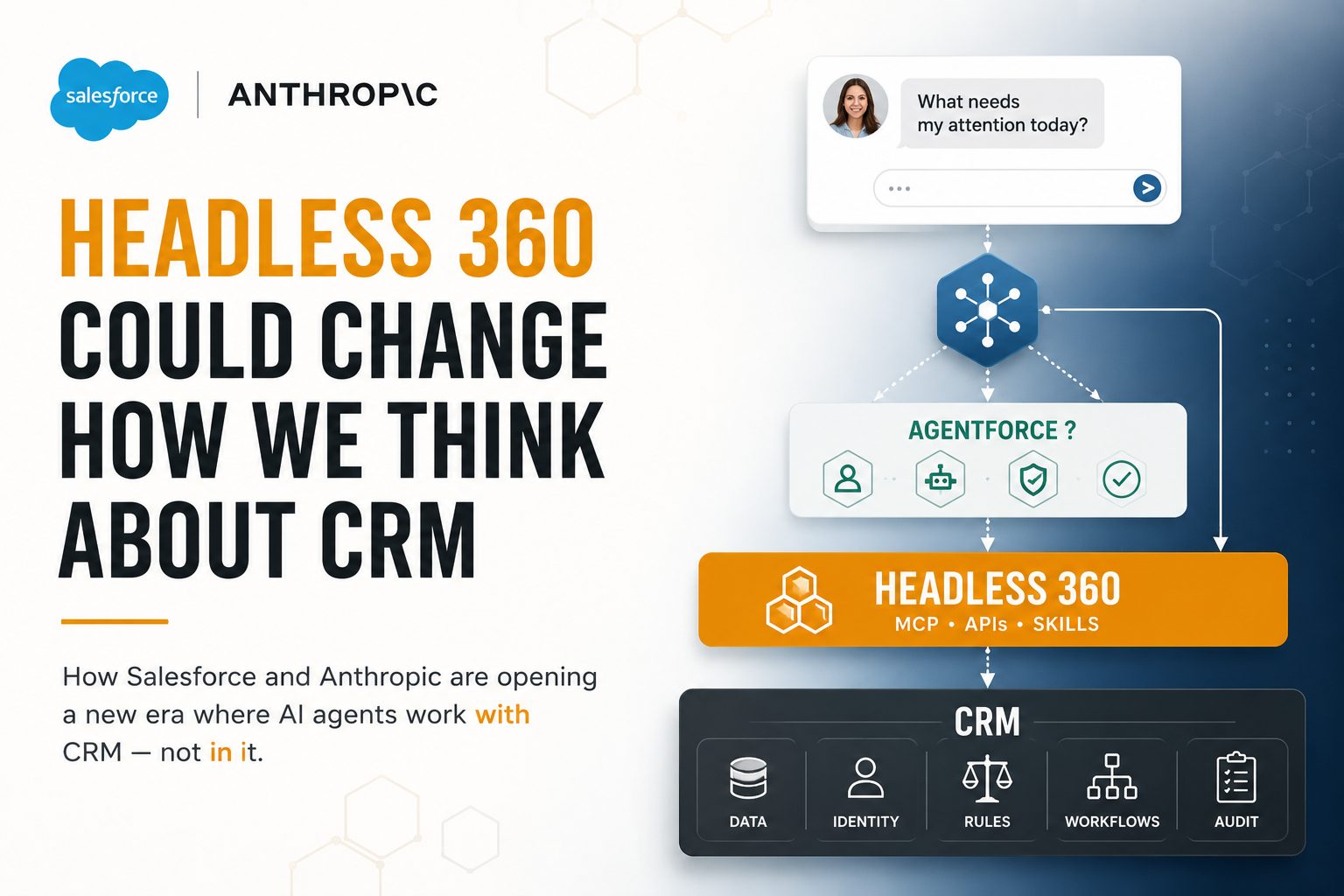
The first AI, created in 1950, was like a strict recipe follower, executing a fixed set of instructions with no room for creativity or adjustment. Today’s AI is more like a skilled chef who tastes, adapts, and invents recipes dynamically, generating creative and responsive outputs. But what if AI could take it even further? Not just generating a recipe, but actively bringing the meal to life by buying ingredients, scheduling reservations, and managing unexpected challenges?
This is the promise of agentic AI: autonomous, proactive AI agents that use large language models (LLMs) to understand complex contexts, reason through decisions, and take independent actions to complete specialized tasks.
Introducing Salesforce Agentforce: Autonomous AI Agents to Scale Your Workforce
Salesforce Agentforce is a revolutionary new layer on the Salesforce Platform that empowers organizations to build and deploy these autonomous AI agents. Industry leaders like OpenTable, Saks, and Wiley are already using Agentforce to enhance their teams, scale operations, and elevate customer experiences.
While trust in autonomous AI remains cautious today, 77% of workers believe they will trust AI agents in the future, revealing a tremendous opportunity for businesses ready to adopt and integrate AI into their workflows in 2025 and beyond.
How AI Agents Will Change the Way We Work
An estimated 41% of employee time is currently spent on repetitive, low-impact work. Salesforce leaders foresee a future where AI agents handle these routine tasks, freeing humans to focus on strategic, relationship-driven work that actually moves the needle on revenue and innovation.
1. AI Will Become Simpler and More Actionable
“AI will become easier to implement within day-to-day business applications, allowing companies to securely integrate agents that use customer and business data to support processes,” explains Steve Hammond, EVP of Marketing Cloud. “This combination of ease and real-time actionability will boost confidence, utilization, and business value.”
2. Analytics Will Be Ambient and Seamless
By 2025, Nate Nichols, VP at Tableau, predicts that 25% of all analytical insights will be delivered ‘ambiently’, meaning AI will proactively surface insights embedded within daily workflows without users needing to seek them out. Whether it’s a smart suggestion during a meeting or a notification on a wearable device, data-driven decision-making will become effortless.
3. AI Agents Will Become the New Apps
Jayesh Govindarajan, EVP of Salesforce AI, compares AI agents to mobile apps in their transformative potential. These agents will be highly customizable and autonomous, capable of anticipating needs and optimizing tasks across industries. Conversational and embedded in workflows, they will elevate productivity and scale business operations intelligently.
4. New Jobs Will Demand Hybrid Skills
Lori Castillo Martinez, EVP of Talent Growth & Development, highlights the importance of cultivating a new blend of skills: technical, human, and soft. The future workforce will need programming and data analysis know-how, along with creativity, emotional intelligence, and problem-solving abilities to thrive alongside AI agents.
5. Mastering Unstructured Data Will Be Key
With 80% of enterprise data unstructured, Sarah Walker, COO of Slack, notes that the companies that can harness and make AI-ready this unstructured data will outperform competitors. From customer sentiment analysis to generating strategic content, the ability to navigate this data will define success in 2025.
6. Upskilling Will Be a Business Priority
Nathalie Scardino, Chief People Officer, predicts 2025 will be the year of upskilling, as companies race to equip employees with AI tools and knowledge to remain competitive. Employees will increasingly choose employers who invest in their continuous development.
7. AI Will Redefine the Employee Experience
Relina Bulchandani, EVP of Real Estate and Workplace Services, sees AI agents transforming how workers use office spaces, from booking meeting rooms to optimizing real estate portfolios, creating more efficient and collaborative workplaces.
How AI Agents Will Transform Industries
The impact of AI agents will differ across industries, unlocking new possibilities tailored to their unique needs.
1. SMBs Will Leapfrog Larger Competitors
Kris Billmaier, EVP of Sales Cloud, sees small and midsize businesses (SMBs) leveraging AI agents to scale rapidly, streamlining operations, engaging customers, and delivering personalized marketing. AI will empower these companies to compete and even surpass larger rivals.
2. Goodbye to Cumbersome Nonprofit Annual Reports
Nonprofits will evolve beyond slow, bulky reports, says Lori Freeman, VP & GM of Nonprofit. Donors will directly engage with AI agents that show real-time impact, provide proof points, and enable instant giving or volunteering, revolutionizing donor engagement.
3. AI-Powered Retail Experiences
Michael Affronti, SVP of Commerce Cloud, envisions AI agents transforming retail by providing personalized shopper assistance, especially during peak seasons. With AI already influencing 16% of sales in recent months, personal shopper agents will become a must-have for digital retailers.
4. Scaling Nonprofit Impact with AI Agents
Nonprofits are early adopters of AI, with 90% using it to boost engagement, according to Molly Ford, VP of Employer Brand. AI agents will help nonprofits optimize staffing, co-create volunteer roles, and connect employees to local volunteering opportunities.
5. Education Will See Rapid AI Adoption
Margo Martinez, VP of Education, explains how AI agents will help educational institutions understand costs at a granular level and reduce staff burnout by taking on scheduling and enrollment tasks. These agents will be crucial for managing seasonal surges in demand.
6. Government Services Will Become More Accessible
Nasi Jazayeri, EVP of Public Sector, predicts that by the end of 2025, AI agents will be widely deployed across federal and local agencies, helping citizens quickly renew passports, register vehicles, and understand benefits, making government services easier and more efficient.
How Humans Will Interact with Agents in the Future
Salesforce leaders offer deep insights into how AI agents will change our daily work and customer interactions.
-
Copilots will become commonplace, evolving from simple assistants to business-aware agents that handle strategic tasks (Adam Evans, EVP, Salesforce AI Platform).
-
We’ll see multi-agent teams tackling complex challenges, simulating product launches or marketing strategies with advanced reasoning (Mick Costigan, VP, Salesforce Futures).
-
Growing confidence in AI will accelerate adoption, transforming customer engagement and workflows (Rob Seaman, Chief Product Officer, Slack).
-
AI agents will become the preferred channel for customer interactions, requiring businesses to create cross-functional teams focused on optimizing AI experiences (Jon Belkowitz, Senior Director, Marketing Cloud).
-
The rise of personal AI agents will prompt companies to integrate “bring your own AI” policies (BYOAI) to keep pace (Mick Costigan).
-
Agentforce Inspectors will provide continuous monitoring and instant actions to improve business outcomes (Ryan Aytay, CEO, Tableau).
-
AI agents will collaborate in swarms, working together to solve strategic tasks seamlessly (Silvio Savarese, Chief Scientist, Salesforce AI Research).
-
Agents will fix fragmented customer journeys by sharing data and orchestrating smooth transitions between teams (Gabrielle Tao, SVP, Product Management).
The Bottom Line
Agentic AI represents a paradigm shift, from AI that assists to AI that acts autonomously and collaboratively. With Salesforce Agentforce, businesses can automate repetitive tasks, unlock strategic human potential, and transform industries through trusted, intelligent AI agents.
The future will be defined by humans and AI agents working side-by-side, combining creativity, empathy, and judgment with scalable autonomous execution to deliver extraordinary outcomes.