On May the 4th, 2026 I started a new adventure as a data engineer at Digital Hive. May the force be with me! After more than four years of working on my PhD, I was ready to leave the academic world behind and start something completely different. My first mission was to learn Snowflake from the ground up and pass the SnowPro Core certification exam before the end of June.
Timeline and prep
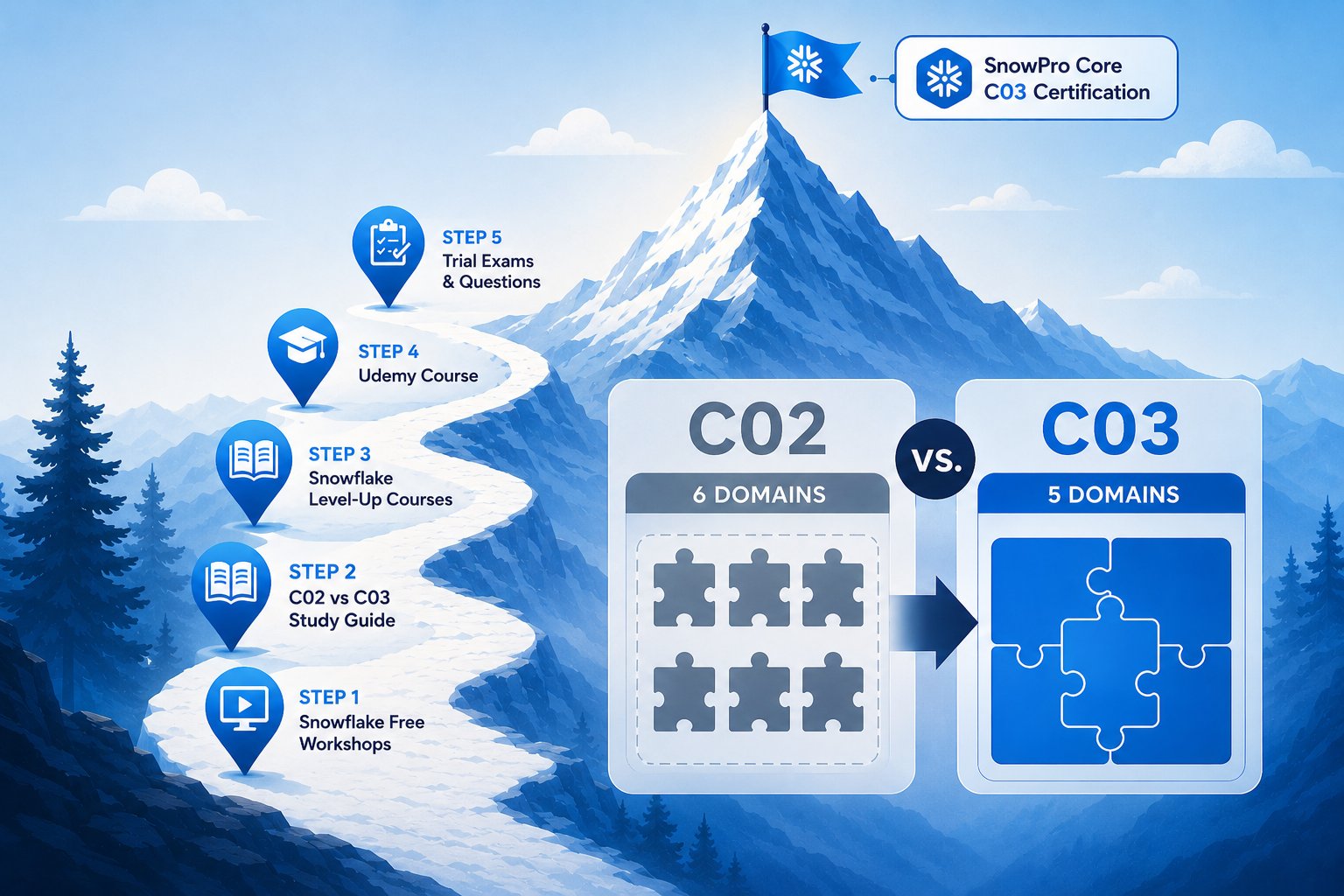
Step 1: Snowflake’s free on-demand workshops
I learn best hands-on, seeing the theory play out in front of me, rather than just reading about it. Snowflake’s on-demand workshops turned out to be a great fit for that, and honestly, a fun way to spend my first weeks. There are six in total, each built around exercises, and completing one earns you a badge. When I ran into an issue, the Snowflake Community had the answer.
Step 2: The SnowPro Core COF-C03 study guide
Once I had some hands-on experience, I wanted to know exactly what I was up against, so I went looking for the exam study guide. That’s when I got my first real surprise: a brand-new version of the exam had just replaced the old one, C03 instead of C02. Suddenly I could no longer fully rely on tips and tricks from people who took the exam earlier. To understand what had changed and cover all my bases, I compared the C02 and C03 study guides and made a personal study plan.
Step 3: The Snowflake Level-Up courses
Next, I worked through the Level-Up courses, which dig deeper into Snowflake’s theoretical side. They gave me a wider vocabulary and a better grip on the underlying concepts. But my colleagues had warned me that the exam would be heavily theoretical rather than hands-on, and after finishing these courses I still felt I was missing some depth.
Step 4: The Udemy course
This is where things really clicked. Training for Snowflake SnowPro Core Certification [COF-C03] walked through nearly every term I’d end up seeing on the exam, backed by clear visuals and hands-on exercises that made the concepts stick, much better than reading documents. It also followed a more logical build-up than the Level-Up material. Better still, it already had dedicated videos for the new C03 content, and the instructor sprinkled in tips on common exam traps along the way. The trial exam at the end was a nice way to check my progress, though it wasn’t as difficult as the real exam.
Step 5: Trial exams and questions
With one week to go, it was time to test what I already knew. I began with SkillCertPro, on a colleague’s recommendation. The questions were noticeably harder, and each came with a clear explanation of why an answer was right or wrong. Whenever I hit a term I didn’t fully know, I asked Claude to walk me through it on the spot.
After a few rounds, though, something felt off: the new C03 topics weren’t showing up nearly often enough. That sent me looking for an alternative, and I landed on CertSafari. There I could choose between a full exam weighted like the real thing or questions on one specific domain, and at the end of a test it flagged exactly where I needed more work. The tests felt more current, with far more questions on the new C03 material and scenario-based questions closer in style to the real exam. The difficulty fell a notch short of the real exam, though. Unfamiliar terms got the same treatment as before: a deep dive with Claude, then trying it out in my own Snowflake account, because seeing something work is what makes it stick for me.
In the end, the combination of these two platforms was exactly what I needed.
The exam
There it was, 30 June 2026, exam day. I’d chosen to take it at an exam center, so my only real worry was getting there on time. The moment I walked into the building, I slipped into exam mode. And yet I was more nervous than I’d ever been for an exam at university, which genuinely caught me off guard.
After checking in at the front desk, I sat down in the exam room with my heart pounding. I was still nervous during the first 15 to 20 questions, but after a while I calmed down. I took the time to read the questions carefully, sometimes more than once, so I wouldn’t click too fast and regret it. Time flew, though I still had a few minutes at the end to revisit the questions I’d flagged, and I promised myself not to overthink them.
When the 100 questions and 115 minutes had passed, the nerves came rushing back. Did I do well enough? The courses and practice exams had prepared me well, but the real questions still felt a shade trickier than anything I’d trained on. So I sat there, unsure, right up until the screen showed one word: PASS. A weight lifted off my shoulders as I walked out. I was very happy I hadn’t let myself or my new employer down.
What’s new in C03
I never took the C02 exam myself, but I did compare the study guides. How different were the two really? Which topics should you watch for, and how can you tell when a resource isn’t up to date yet?
The first thing that jumped out was the weighting. Domains got restructured, merged and rebalanced, and six domains became five:
| C02 domain | C02 weight | C03 domain | C03 weight |
|---|---|---|---|
| 1.0 Snowflake AI Data Cloud Features and Architecture | 24% | 1.0 Snowflake AI Data Cloud Features and Architecture | 31% |
| 2.0 Account Access and Security | 18% | 2.0 Account Management and Data Governance | 20% |
| 3.0 Performance and Cost Optimization Concepts | 16% | (merged into 4.0) | |
| 4.0 Data Loading and Unloading | 12% | 3.0 Data Loading, Unloading, and Connectivity | 18% |
| 5.0 Data Transformations | 18% | 4.0 Performance Optimization, Querying, and Transformation | 21% |
| 6.0 Data Protection and Data Sharing | 12% | 5.0 Data Collaboration | 10% |
Percentages only tell you where to spend your study hours. They don’t tell you what’s actually new underneath. Here’s what I found, domain by domain.
1.0 Architecture grew the most, in weight and in substance. Warehouses are no longer one generic bullet point, and Cortex went from a footnote to a full subsection:
- Gen 1 and Gen 2 warehouses, plus a dedicated Snowpark-optimized warehouse type
- Apache Iceberg tables and dynamic tables, both new on the table-type list
- Parameters, their hierarchy and precedence, called out explicitly for the first time
- Snowflake CLI and IDE integrations (VS Code), replacing SnowSQL and SnowCD, which are gone entirely
- Cortex: AI SQL functions, Cortex Search, Cortex Analyst
- Snowflake ML
- Snowflake Notebooks and Snowpark in Notebooks
2.0 Governance is where entirely new ground appeared. Security and governance aren’t a side quest anymore, they’re core knowledge. None of these existed in C02:
- OAuth, secondary roles, account identifiers, logging and tracing
- Data lineage, privacy policies, encryption key management, alerts and notifications
- Trust Center, a feature for benchmarking your account against security best practices, which even made it into the sample questions
- An explicit role taxonomy (system-defined, account, database, custom) and Discretionary Access Control by name, where C02 only spoke vaguely about “access control frameworks”
3.0 Loading and connectivity got built for how teams actually ship data now:
- Snowpipe Streaming, as its own ingestion method next to standard Snowpipe
- Dynamic tables, reappearing here under automated ingestion
- Git integration, right alongside storage and API integrations
4.0 Performance kept the same ideas but sharpened the language. C02 spoke generically about “data spilling”. C03 names exact failure patterns, exploding joins and queuing, directly.
5.0 Collaboration, the smallest domain, still picked up new material: reader accounts, data clean rooms and Native Apps all appear in C03 with no equivalent in the old guide.
One last detail: buried in the fine print, C03 flags Openflow and a default warehouse for Notebooks as not yet testable until they reach general availability. A small preview of what’s still on its way to the platform.
Bottom line
C03 isn’t just C02 with a new coat of paint. Governance and security have become a real pillar rather than an afterthought, AI and Git are now first-class citizens instead of footnotes, and the exam leans more on judgment (often scenario-based) than on memorized syntax. Same certification name, same 115 minutes, different questions underneath. If you’d studied for C02 and walked into a C03 exam room, you’d have found the ground had shifted more than the shared name suggests.
Looking back at the study guide now that I’ve passed, my advice boils down to this: know every term listed across the five domains in the official study guide. The clearest sign you’re ready is working through trial questions and recognizing each term when it shows up, knowing its key specifications and, ideally, answering correctly. If a term still feels unfamiliar, that’s your signal to dig deeper. For me, the Udemy course combined with practice questions is what got me there: not just recognizing the words, but understanding what sits behind them.
So if you’re gearing up for your own SnowPro Core attempt: the Force is a good start, but a solid study plan will get you a lot further than luck alone. May the C03 be with you.