Salesforce and Anthropic announced Claudeforce this week, bringing Claude much deeper into the Salesforce ecosystem. Claude will be able to work with Salesforce data and actions, while Salesforce is also making Claude available within Agentforce and other parts of its AI stack.
There is plenty to unpack in the partnership itself, but one part of the announcement caught my attention more than anything else: Headless 360.
I think this is potentially much more important than the introduction of yet another AI assistant. It points towards a fundamental change in how we interact with CRM systems, and I expect that change to become very visible over the next two years.
From working in CRM to working with CRM
CRM has traditionally been an application that users have to actively work in. A salesperson opens Salesforce, navigates to an account or opportunity, looks at activities and dashboards, interprets that information and decides what to do next. Afterwards, they update the opportunity, create a task or move to another application to send an email or discuss something with a colleague.
We have spent a lot of time over the years trying to make that experience better. We simplify page layouts, remove unnecessary fields, build better dashboards and automate administrative tasks. A significant part of CRM adoption is ultimately about making it as easy as possible for people to correctly use the system.
Headless 360 starts to challenge that model.
Salesforce is exposing its applications and business capabilities so that authorized AI agents can discover and invoke them through technologies such as MCP and APIs. Those agents don’t necessarily have to live inside Salesforce. Salesforce explicitly mentions Agentforce, Claude, ChatGPT, Cursor and other AI platforms.
That means the user no longer necessarily needs to go through the Salesforce interface to use Salesforce.
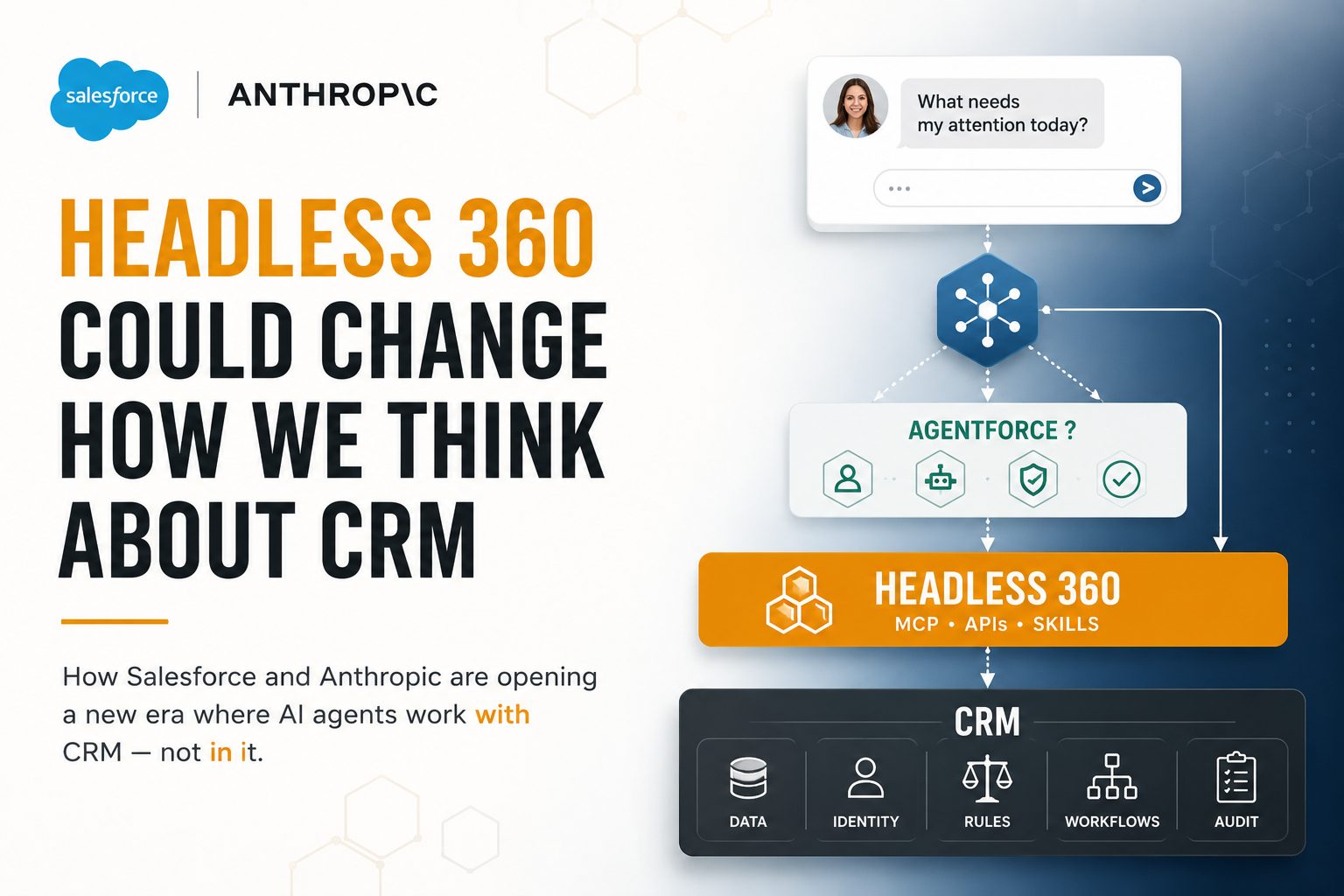
Imagine a salesperson starting the morning in Slack and asking what deserves their attention today. An AI agent could analyze the pipeline in Salesforce, combine it with recent customer communication, documents and internal conversations, and identify a few opportunities that require action. Instead of simply presenting a dashboard, it can explain why those opportunities matter and suggest what should happen next.
The user can then continue the conversation and ask the agent to execute those actions. Salesforce is updated, tasks are created and the appropriate workflows are triggered in the background.
The important thing is that Salesforce hasn’t disappeared from this scenario. In fact, almost everything still depends on Salesforce. What has disappeared is the requirement for the user to interact directly with the Salesforce application.
That is a very different definition of CRM.
Salesforce as a business platform rather than a user interface
The move towards headless architecture isn’t unique to CRM, but applying it at this scale to enterprise applications has interesting consequences.
Salesforce can increasingly become the underlying business platform that provides customer data, permissions, metadata, workflows and business logic, while another layer determines how users interact with those capabilities.
Today, we still tend to think of a Sales Cloud implementation as an application. In a more headless future, Sales Cloud could increasingly be considered a collection of trusted business capabilities that can be consumed by humans, agents and other applications.
An AI agent doesn’t need to understand where a particular button sits on an Opportunity page. It needs to understand what an Opportunity is, what information is available, which business rules apply and which actions it is allowed to perform.
That distinction matters.
It also explains why I find Headless 360 strategically more interesting than Claudeforce itself. Salesforce is effectively accepting that it doesn’t necessarily need to own the interface through which users consume Salesforce.
If Salesforce can remain the trusted layer underneath those interfaces, it can benefit regardless of which AI assistant ultimately becomes dominant.
Slack could become a much more logical place to work
This also makes Slack particularly interesting within the Salesforce ecosystem.
CRM has never been the place where all work happens. Teams discuss opportunities, customers and projects elsewhere. Documents live in different systems. Decisions are made in conversations and meetings. CRM is often the place where the result of that work is eventually recorded.
An AI agent changes that relationship because it can connect the conversation with the underlying business systems.
A discussion about a customer in Slack could immediately include the relevant Salesforce context without someone having to open the account. The agent could identify missing information, retrieve a document, explain the status of an opportunity and eventually execute an action in Salesforce.
That feels like a more natural working model to me than trying to move every activity into CRM.
It also makes Salesforce’s ownership of Slack strategically important. Slack can become the collaboration environment where humans, documents and AI agents come together, while Salesforce provides much of the structured business context and execution behind it.
But where does this leave Agentforce?
This is the part of the announcement where I still have more questions than answers.
Claude is becoming an increasingly capable general-purpose agent. It can reason across documents, conversations and multiple enterprise systems. With Headless 360, it can now also discover and invoke Salesforce capabilities.
At the same time, Salesforce continues to invest heavily in Agentforce and is integrating Claude as a reasoning model within it.
That creates an interesting overlap.
If Agentforce is primarily positioned as an intelligent assistant that understands Salesforce and performs Salesforce actions, I think it risks being surpassed by general-purpose agents such as Claude. Those agents aren’t limited to the Salesforce ecosystem and can reason across a much broader working context.
However, I don’t think that necessarily makes Agentforce obsolete.
Its role may simply have to evolve.
Instead of competing with Claude on intelligence, Agentforce could become the Salesforce-native orchestration and governance layer for agents. It could determine which capabilities an agent can use, which actions it can execute, when human approval is required, which model is appropriate for a particular task and how all of those actions are monitored.
In that model, Claude and Agentforce aren’t necessarily competitors.
Claude can provide much of the reasoning, while Agentforce provides the controlled environment in which that reasoning can safely interact with Salesforce.
I think this distinction will become important over the coming years. Salesforce will need to make the boundaries between Claude, Agentforce and Headless 360 increasingly clear. If all three are presented as different ways of creating intelligent Salesforce assistants, the proposition becomes confusing. If they become distinct layers in an enterprise AI architecture, the combination becomes much more compelling.
Governance becomes more important as the interface disappears
There is another reason why I don’t think Salesforce becomes less relevant in a headless world: governance.
Reading Salesforce data with an AI assistant is relatively straightforward. Allowing an agent to actually perform business actions is a completely different matter.
Once an agent can update forecasts, change customer information, generate quotations, trigger approvals or communicate with customers, organizations need very clear answers to some basic questions.
What is the agent allowed to see? Which user is it acting on behalf of? Which actions can it execute autonomously? When does a human need to approve something? Which existing business rules still apply? And can the organization afterwards understand what the agent did and why?
This is where Salesforce has a significant advantage.
Organizations have spent years building their identity models, permissions, workflows, validation rules, approval processes and business logic into Salesforce. Headless doesn’t mean bypassing that layer. The value is precisely that external agents can use Salesforce capabilities while those controls remain in place.
In my view, this will become one of the most important architectural principles for enterprise AI.
The smartest model won’t automatically win in an enterprise context. Organizations also need a reliable execution layer around that intelligence.
This will also change what a good CRM implementation looks like
The consequences go beyond Salesforce’s product strategy.
If users increasingly interact with CRM through AI agents, some of the things we currently spend significant implementation effort on will become less important, while others become considerably more important.
We will probably spend less time debating exactly where a field should appear on a page or how many clicks a salesperson needs to perform a certain action.
Instead, the quality of the underlying CRM model becomes critical. Data needs to be structured correctly. Business processes need to be explicit. Permissions need to make sense. Automations need to be predictable. The meaning of data needs to be clear enough for an agent to correctly interpret it.
Data quality becomes even more important as well. Poor data is annoying when a human is looking at a dashboard. Poor data becomes dangerous when an autonomous agent is making decisions and executing actions based on it.
The same applies to badly designed processes. AI can make a good process dramatically more efficient, but it can also execute a bad process at unprecedented speed.
For CRM consultants, I think this accelerates a shift that was already happening. Deep product knowledge will remain valuable, but knowing which Salesforce button to configure becomes less differentiating. Understanding the business, designing good processes, structuring data and translating business objectives into governed technology becomes much more important.
The next two years could fundamentally change CRM
I don’t expect traditional CRM interfaces to disappear in two years. There will still be users working directly in Salesforce, and there will still be plenty of use cases where a structured application interface is the best way to work.
But I do think the balance will change quickly.
The question we have asked for years has been: how do we get users to work better in CRM?
Headless 360 introduces a different question: how can CRM support users wherever they are already working?
That sounds like a subtle distinction, but architecturally it is enormous.
Claudeforce is an interesting announcement and the Anthropic partnership will undoubtedly get most of the attention. I’m particularly curious to see how Claude and Agentforce will coexist as both products mature.
But for me, Headless 360 is the part to watch.
If Salesforce succeeds in turning CRM from an application people have to visit into a trusted business platform that agents can securely use from anywhere, we aren’t just looking at another generation of Salesforce.
We’re looking at a different way of working with CRM altogether.